Design domain part1
——Digital colonies: Redefining the form of life


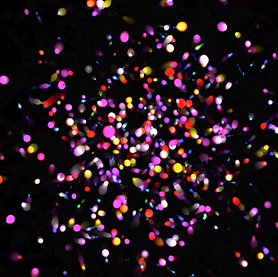


In this project, I aim to explore the concept of "form" by studying the generation and cultivation of life forms in nature, with a particular focus on fungi, an important and often misunderstood component of ecosystems. Through this project, I hope to reveal the unique beauty of mold and its ecological value and inspire people to re-examine this natural phenomenon. A chance discovery inspired me: mold had grown on a painting, long stored in a damp corner. These mold patterns are complex and diverse, with unexpectedly beautiful colors and forms that defy traditional stereotypes of "gross" or "ugly."
mindmap of “from”

mindmap of “mold”

Through the study of mold, I have a deep understanding of the basic color and general shape of mold. Molds usually have a chain or radial structure, and their spores are connected to each other by spore peduncles. Although in some cases mold can have a negative impact on human health or industrial processes, if properly used, it has the potential for sustainable development in the development of drug-resistant biomaterials and environmental remediation. This dual property reveals the complexity of mold as an organism, which is both a challenge and an opportunity.
In Part 1 of this project, I plan to use TouchDesigner* software to design generative electronic mold patterns based on mold forms, so as to visually let people feel the beauty of mold. The goal of this stage is to redefine the image of mold in people's minds, transforming it from "ugly" or "disgusting" to the embodiment of natural aesthetics.
In Part 2, I hope to combine the growth conditions of mold, such as humidity and temperature, and detect the change of these environmental parameters through the **Arduino** sensor, so as to control the generation of electronic mold. This will allow people to intuitively "grow" their own electronic molds by adjusting environmental conditions. In addition, I plan to add materials research, such as cotton and pigments, to make an installation with a physical dimension. This device will simulate mold form in a more three-dimensional way, no longer limited to the representation on the screen but to interact with the real environment.
Through this project, I hope to explore the unique beauty of mold and its ecological potential, encouraging people to revisit this misunderstood natural phenomenon.
Interviewing my friends
Q1: What was your first impression of mold?
A: I think mold is a very common existence in nature, but because it is easy to cause food deterioration, the impression is not good.
Q2: What do you think is the role of mold in ecosystems?
A: It's a decomposer, able to break down organic matter and recycle nutrients back into the ecosystem.
Q3: Do you understand the use of mold in industry or medicine?
A: I know that mold can be used to produce antibiotics, such as penicillin, and also in food fermentation.
——
Q4: Have you ever personally observed mold?
A: Yes, I have seen mold on moldy fruit and bread.
Q5: If you have ever seen mold, how does it make you feel?
A: It looks disgusting, but if you look closely, you'll find its shape is quite complicated.
Q6: Have you ever observed mold details through a microscope or other means?
A: Yes, in science class at school. You can see spores and mycelium.
——
Q7: Do you think mold has artistic value?
A: Yes, there is an unexpected beauty to the combination of forms and colors.
Q8: Would you be interested if mold were reimagined as a digital art form?
A: Yes, I think digital art can help us better discover the unique beauty of mold.
Q9: Do you think mold forms can inspire other design fields (such as architecture, clothing, product design)?
A: Yes, I think the branched structures and expanded forms of mold can be used in bionic designs, such as clothing patterns or architectural appearances.
——
Q10: If you could "grow" digital mold by controlling humidity, temperature, etc., would you be willing to try?
A: I'd love to. It sounds like an interesting and unique experience.
Q11: Are you interested in devices based on sensor-based interactions, such as influencing mold morphology through environmental conditions?
A: Yes, I'm interested in learning how different conditions affect mold growth.
Artists research


Tracy Debenport specializes in the study of fungi, as well as pathogens and beneficial microorganisms mainly associated with agriculture. Her artwork is often created by accident, when certain microorganisms grow to produce "unexpected patterns or compositions." "In those moments, I was inspired by their beauty and had to document it immediately."
Tracy believes that molds and yeasts play key positive roles in our ecosystems that people outside of these fields may not be aware of. "In addition to sharing this science, we want to create a positive connection for people with microbes," which could also benefit the agricultural and medical fields. "Many people think of pathogens and contaminants when they hear the word 'mold,' but there are many more types of mold that are beneficial than harmful." "I want my art to show its true beauty."


"Rotten and gorgeous jewel fruit."
Kathleen Ryan is a sculptural artist living in New York City, known for making materials such as jewelry in oversized, mold-covered, bad fruit sculptures, creating a dialogue between the beautiful and the grotesque.
Rotting, gorgeous fruit covered in bruises, mildew of various colors, and drosophila flecks is usually associated with decay and disgust, but for Kathleen, waste is the most important character in her creation, and these contradictory elements are mixed together to reflect on her modern society.


DASHA PLESEN is an artist who grows mold into unique and beautiful bacterial compositions. She pushed the boundaries between science and art through her work.
Artists add various bacteria and other organisms to petri dishes, then place additional elements (such as fluffy balls, sugar, and powdered sugar) into containers. These artificial additions stunted growth, producing countless hues and structures, and bred otherworldly compositions with unnatural saturated colors, fuzzy patches, and trumpet rolls of slime in a single container.
Dasha's work focuses on the process of "seeding." Her work can be considered performance art because she collects microbes from the air and everyday objects around her, and sometimes even from her own body. It is then wiped onto her nutrition canvas, usually in the form of a petri dish. A set of images she created is not always the final piece, as her life works have been shown, along with some textiles made from these images.
Her ideal working environment would be a living space full of energy, light, happiness, and hope, with plenty of sunshine, cool air, green flowers, fruits, berries, and loud songs, as well as the smell of incense. She likens it to a semi-laboratory farmhouse on an island, nestled between the sea and the jungle, with a Faust and Robinson vibe. She also mentioned specific requirements when it comes to the brand's rigorous culture, such as growing specific types of mold in a sterile lab.

Reis: "Each painting represents a microcellular response. Combining the two fields of science and painting, she is "exploring and documenting the natural and unnatural world with a strange and hopeful sense."
A Daily Dish.
The "A Daily Dish" series of works is created in petri dishes using epoxy polymers, mixed substances and industrial dyes. Different from ordinary paintings, it is more dangerous and must be completed under the condition of wearing a gas mask and protective clothing.
I am amazed and amazed by the work these artists have created by cultivating mold. I think they showed a lot of patience and focus in their work. For example, Reis's work "A Daily Dish" impressed me deeply, and he insisted on updating one piece of work on the social platform every day. The persistence and perseverance are admirable, and I love that these generative patterns show the incredible beauty of mold.
mold sketch

sketch of my design in TD

Design process in TD


Apply null and noise to create an overlapping feeling like mold
I use instance replication to create model instances, especially like mold growth, similar objects are handled very efficiently, based on the sphere, and the size is changed by transform. Using transform and translate, and using the code absTime.seconds/100, each ball position changes slower. Finally, the feedback-level function is used to make the trailing effect like mycelium.


What I want to do in part2
In order to regulate the creation of electronic mold, I intend to integrate the mold growth conditions, such as temperature and humidity, and use an Arduino sensor to identify changes in these environmental factors. By modifying the surroundings, people will be able to "grow" their own electronic molds in an intuitive way. In order to create an installation with a tangible aspect, I also intend to incorporate materials research, like cotton and pigments. In addition to being able to interact with the actual environment, this device will more realistically replicate mold formation in three dimensions.
I want to encourage people to reexamine this misunderstood natural phenomenon by examining the ecological potential and distinctive beauty of mold.